• Sign Up! To view all forums and unlock additional cool features

    Welcome to the #1 Dodge, Jeep and RAM Forum dedicated to FCA owners and enthusiasts. Register for an account, it's free and it's easy, so don't hesitate to join the SRT Forum today!


DSC Suspension Controller - tuning and talk

OP
DGatzby

DGatzby

9000 Posts Club
Founding Member
Premium Account
U.S. Air Force Veteran
Donating Member
HFCOTM & HFCOTY
Member ID
#797
Messages
9,597
Reactions
56,552
Likes
402
City
SW Twin Cities
State
MN
Country
United States
Vehicle
2019 Dodge Challenger Redeye WB
Thread Starter #22
Great summary @rayzazoo. I really CAN feel the independent shock control just driving down the street. That is one of its big differences that I have enjoyed.

The one item that looks interesting is the comfort numbers, and the most easy to change. Less is softer as the default or at no input from driver. Sport rides more soft than street! I am going to drive it a bit today and see if I can feel the ride difference btw Street and Sport. I’ll start there.

Let’s hear more about the acceleration deal. Ray says 1500ms, I may just change it and see if I can perceive something there too. :p It can accelerate if I want it to.:rolleyes:


Member ID
#7706
Messages
1,715
Reactions
2,482
Likes
162
City
Clementon
State
NJ
Country
United States
Vehicle
2018 Charger
#23


Member ID
#1482
Messages
146
Reactions
468
Likes
67
City
Somewhere
State
Non-US
Country
United States
Vehicle
Hellcat
#24
Great summary @rayzazoo. I really CAN feel the independent shock control just driving down the street. That is one of its big differences that I have enjoyed.

The one item that looks interesting is the comfort numbers, and the most easy to change. Less is softer as the default or at no input from driver. Sport rides more soft than street! I am going to drive it a bit today and see if I can feel the ride difference btw Street and Sport. I’ll start there.

Let’s hear more about the acceleration deal. Ray says 1500ms, I may just change it and see if I can perceive something there too. :p It can accelerate if I want it to.:rolleyes:
I think it'll be dependent on the setup. Once you hit 60mph or the threshold timer, the acceleration table is done.

So let's say est. 0-60mph - threshold timer = time not in accel table
Hellcat 3.7 s - 1.5 s = 2.2
Redeye 3.4 s - 1.5 s = 1.9
SS 3.25 s - 1.5 s = 1.75

Diablosport only spent 1 second in the accel table while DSC had 2 seconds. When Mike from DSC was made aware of the DS controller, the feedback was 1.5 seconds might be the sweet spot, but that was also for a 2015 Hellcat. Once the timer is done, it goes back to the GForce table and %.

Another thing to consider is actual 60ft times. If these are <2 seconds, then it helps explain why DiabloSport elected for only 1 second vs DSC 2 seconds.

I think a more accurate measurement is log personal 0-60 ft times. Then tweak the threshold timer.

Next, tweak the acceleration table % on the desired amount of front and rear.

Interestingly, the 2018 Demon launch suspension strategy: "Bilstein adaptive dampers are set to firm up compression and rebound in the rear while softening front rebound, letting the front end rise freely as weight shifts entirely to the back wheels" Great for a wheelie.

Then the 2023 Demon 170 "raises the nose more slowly, putting more energy into forward acceleration instead of a dramatic wheelie." Slower front rise.

Between these observations and @catdad settings of 100 (firm) / 10 (soft), it could explain why it's a more planted feeling with little to no wheel spin.

Controlled front extension with maximum rear compliance—reducing wasted pitch and oscillation while maintaining rear-tire loading.

That is much closer to the Demon 170 philosophy than the factory DSC 10/20 soft-front/soft-rear launch map. @catdad phrase “a ton of pressure on the rear” is describing rear-tire loading, not firm rear damping.

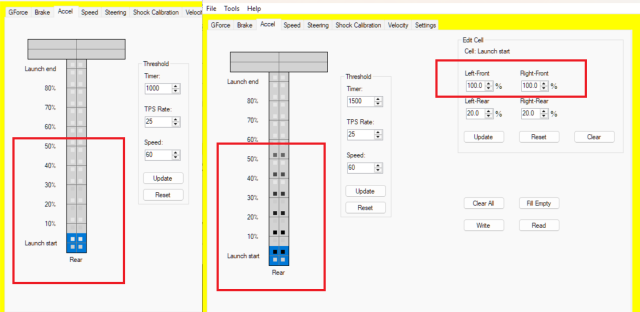
Comparing the G-force table at 0.6 and Launch Start accel table:

OEM launch calibration
Front: 60% → 10%
Rear: 80% → 20%

Both ends become dramatically softer. The front can extend easily, and the rear can compress easily. This encourages weight-transfer motion, but it can also create more pitch, oscillation, or wheel hop.

User calibration
Front: 60% → 100%
Rear: 80% → 10%

This is a radically different strategy:

Front becomes much more controlled.
Rear becomes almost completely released.

It is best described as:

Firm front, very soft rear.

The acceleration itself still transfers load rearward. The stiff front controls how quickly the nose moves, while the soft rear lets the suspension absorb the torque application and load the rear tires.

For the 100/10, it could be more effective on an unprepared surface or street-oriented tire when the problem is immediate wheelspin.
The DSC 10/20 setting may work better when the surface is prepared and the tires can tolerate a more aggressive weight-transfer event.


Last edited:

Linda's Hell Cat

6000 Posts Club
Staff Team
Founding Member
Premium Account
Donating Member
9 Second Best E/T
Member ID
#972
Messages
6,568
Reactions
42,142
Likes
352
City
Bucks County
State
PA
Country
United States
Vehicle
2015 Charger Hellcat
#25
@rayzazoo it's Great To see you posting up! :):)

Thanks for your knowledgeable and useful information.:cool::cool::cool::cool:

~Linda :)


OP
DGatzby

DGatzby

9000 Posts Club
Founding Member
Premium Account
U.S. Air Force Veteran
Donating Member
HFCOTM & HFCOTY
Member ID
#797
Messages
9,597
Reactions
56,552
Likes
402
City
SW Twin Cities
State
MN
Country
United States
Vehicle
2019 Dodge Challenger Redeye WB
Thread Starter #26
^ nice.

I have some stuff to add for just using on the street. Cleaned it up and went down to spend $70 for this mysterious liquid so it can run for a few miles. Since Sport comfort is more soft initially than Street, first I needed to feel it.

I agree, it sure is fancy and very subtle, but it is softer!

So, without changing their program we may have something there. If Sport (suspension only) has a more aggressive response to our inputs than street AND rides initially more comfy, I’m in.

Okay, I did a read to make sure I was looking at the right numbers. With the exception of this comfort setting I do not see differences btw the three different settings, in these tables. I am no genius but just looking at the G-force table and the braking table, the numbers look identical between the three?


Member ID
#1482
Messages
146
Reactions
468
Likes
67
City
Somewhere
State
Non-US
Country
United States
Vehicle
Hellcat
#27
^ nice.

I have some stuff to add for just using on the street. Cleaned it up and went down to spend $70 for this mysterious liquid so it can run for a few miles. Since Sport comfort is more soft initially than Street, first I needed to feel it.

I agree, it sure is fancy and very subtle, but it is softer!

So, without changing their program we may have something there. If Sport (suspension only) has a more aggressive response to our inputs than street AND rides initially more comfy, I’m in.

Okay, I did a read to make sure I was looking at the right numbers. With the exception of this comfort setting I do not see differences btw the three different settings, in these tables. I am no genius but just looking at the G-force table and the braking table, the numbers look identical between the three?
All of the GForce and braking tables are the same.

Where they differ is the Settings of Chassis Tour, Sport, and Track and how the % on the GForce table references the Shock Calibration Table.

While in the G Comfort "box" of <0.25 g the % in the Default rate is applied to the Shock Calibration Table.

For example,
Tour Default Rate of 34% outputs approximately 400 mA (soft).
Sport Default Rate of 18% outputs approximately 400 mA (soft).
Track Default Rate of 28% outputs 200 mA (firmer).

The acceleration table Launch start.
When launch is activated, the threshold timer of 1-2 seconds applies.
10% front / 20% rear is 400 mA front (soft) / 400 mA rear (soft).
100% front / 10 % rear is 100 mA front (stiff) and 400 mA rear (soft).

Outside of the "box" >0.25 g and acceleration launch, the G Table applies.

Using 0.6 g and 0 left/right results in 60% / 60% front, and 80% / 80% rear.
Applied to the Shock Table
Tour is 200 mA front (softer) / 100 mA rear (firm).
Sport/Track is 100 mA front (firm) / 100 mA rear (firm).

The best part is that you can customize individualized Acceleration Launch Tables for each Chassis setting.

For non-drag racing, the way Mike explained the difference between OEM and DSC is independent references per corner and has a lot more table value references. This helps explain the smooth transition in turns which feels more controlled.

All great stuff and makes me want to go play with the Hellcat today.


Last edited:

catdad

Active Member
Founding Member
9 Second Best E/T
Member ID
#869
Messages
161
Reactions
222
Likes
37
City
Lake City
State
FL
Country
United States
Vehicle
2019 Charger Hellcat
#28
What settings did you need to change?
compression and rebound. also the time it stays in launch mode


OP
DGatzby

DGatzby

9000 Posts Club
Founding Member
Premium Account
U.S. Air Force Veteran
Donating Member
HFCOTM & HFCOTY
Member ID
#797
Messages
9,597
Reactions
56,552
Likes
402
City
SW Twin Cities
State
MN
Country
United States
Vehicle
2019 Dodge Challenger Redeye WB
Thread Starter #29
All of the GForce and braking tables are the same.

Where they differ is the Settings of Chassis Tour, Sport, and Track and how the % on the GForce table references the Shock Calibration Table.

While in the G Comfort "box" of <0.25 g the % in the Default rate is applied to the Shock Calibration Table.

For example,
Tour Default Rate of 34% outputs approximately 400 mA (soft).
Sport Default Rate of 18% outputs approximately 400 mA (soft).
Track Default Rate of 28% outputs 200 mA (firmer).

The acceleration table Launch start.
When launch is activated, the threshold timer of 1-2 seconds applies.
10% front / 20% rear is 400 mA front (soft) / 400 mA rear (soft).
100% front / 10 % rear is 100 mA front (stiff) and 400 mA rear (soft).

Outside of the "box" >0.25 g and acceleration launch, the G Table applies.

Using 0.6 g and 0 left/right results in 60% / 60% front, and 80% / 80% rear.
Applied to the Shock Table
Tour is 200 mA front (softer) / 100 mA rear (firm).
Sport/Track is 100 mA front (firm) / 100 mA rear (firm).

The best part is that you can customize individualized Acceleration Launch Tables for each Chassis setting.

For non-drag racing, the way Mike explained the difference between OEM and DSC is independent references per corner and has a lot more table value references. This helps explain the smooth transition in turns which feels more controlled.

All great stuff and makes me want to go play with the Hellcat today.
Okay. But where does it get the info to become more firm (ultimately or quicker) in Track VS Tour? Even though the OEM controller only worked the four in unison it was ultimately more stiff in Track. Right?

I will say whatever is programmed into Sport handles pretty darn well. Did a round-about and then even was able to hammer it leaving, and some other quick corners seem to feel different and to the better. I tried something that should have at least caused some tire noise- quiet. AND IT STICKS. Interesting.


Member ID
#1482
Messages
146
Reactions
468
Likes
67
City
Somewhere
State
Non-US
Country
United States
Vehicle
Hellcat
#30
Okay. But where does it get the info to become more firm (ultimately or quicker) in Track VS Tour? Even though the OEM controller only worked the four in unison it was ultimately more stiff in Track. Right?

I will say whatever is programmed into Sport handles pretty darn well. Did a round-about and then even was able to hammer it leaving, and some other quick corners seem to feel different and to the better. I tried something that should have at least caused some tire noise- quiet. AND IT STICKS. Interesting.
I really enjoy reading the "hammer it leaving, and some other quick corners seem to feel different and to the better"!
Similarly, I felt I could take corners at higher speed and things just felt planted compared to OEM. In other words, the OEM controller has significantly less independent wheel authority than the DSC controller.

The Tour, Sport and Track differences primarily come from the Shock Calibration table and G-Comfort settings and how quickly the suspension transitions from 400 mA (soft) to 100 mA (firm) vs gForce in each chassis setting.

This example demonstrates acceleration but in corning, each damper is independently operating on a similar, quicker transition as g Force increases.

Tour g = front / rear mA
<0.25 = 400 / 400 (GComfort)
0.25-0.4 = 200 / 200
0.40 g = 200 / 200
0.60 g = 200 / 100
0.80 g = 100 / 100
1.00 g = 100 / 100

Sport g = front / rear mA
<0.25 = 400 / 400 (GComfort)
0.25-0.4 = 200 / 200
0.40 = 200 / 100
0.60 = 100 / 100
0.80 = 100 / 100
1.00 = 100 / 100

Track g = front / rear mA
<0.25 g = 200 / 200 (GComfort)
0.25-0.4 = 200 / 200
0.40 = 200 / 100
0.60 = 100 / 100
0.80 = 100 / 100
1.00 = 100 / 100

The area that I'm tweaking today is the Acceleration Tables for Tour, Sport and Track Chassis. This table is predictive vs. GForce reactive and something I haven't really tweaked. The revisions focus on how the suspension behaves during the first 1–2 seconds of a driver input, before the dynamic control algorithms fully assume control.

Aside from the Launch suspension tweak, I'm focused on a road course suspension setup so we get more of the smooth, controlled cornering we felt from the gForce table (reactive) to the acceleration table (predictive). I always felt coming out of a low speed, low g Force corner that the hellcat was uncontrolled acceleration (perhaps a 400 mA to 100 mA transition) rather than a more controlled acceleration (200 mA to 100 mA).

The acceleration table (10%-80%) starts at 400 mA (predictive) so getting that started at 200 mA (predictive) for Sport/Track chassis setup. Next is tweaking the threshold, TPS and mph settings. We already have a good range of 1000-2000ms for threshold but a higher MPH might keep the suspension out of the 400 mA (predictive) on acceleration and in 200 mA (predictive).


Last edited:

Unholy707

8000 Posts Club
9 Second Best E/T
HFCOTM
Member ID
#11903
Messages
8,836
Reactions
7,755
Likes
402
City
Orlando
State
FL
Country
United States
Vehicle
2015 Dodge Challenger Hellcat
#31
I'd really like to figure out how the 170 is calibrated


Unholy707

8000 Posts Club
9 Second Best E/T
HFCOTM
Member ID
#11903
Messages
8,836
Reactions
7,755
Likes
402
City
Orlando
State
FL
Country
United States
Vehicle
2015 Dodge Challenger Hellcat
#32
I would like to see what the "stock settings" for this would be for hellcat and demon 170, I wonder if they can figure that out


vortecd

Poster Club Hall of Fame
Premium Account
Donating Member
9 Second Best E/T
HFCOTM
Member ID
#1248
Messages
63,223
Reactions
220,647
Likes
402
City
Middleville
State
MI
Country
United States
Vehicle
2016 Charger Hellcat
#33
I'd really like to figure out how the 170 is calibrated
You have a 15 and me a 16 but if we had an 18 or newer I believe @Jon-MooredPerformanceLLC was able to add some drag mode that changed the shock settings


Unholy707

8000 Posts Club
9 Second Best E/T
HFCOTM
Member ID
#11903
Messages
8,836
Reactions
7,755
Likes
402
City
Orlando
State
FL
Country
United States
Vehicle
2015 Dodge Challenger Hellcat
#34
Yeah, I'm curious if the DSC could mimmic the 170 suspension settings or if they're going about it completely differently


Top